With the rapid development of modern architecture, interior decoration, luxury construction projects, and customized building materials, the stone processing industry has undergone a dramatic transformation. Traditional manual cutting methods have gradually been replaced by automated and intelligent manufacturing systems. From rough stone slab production to highly sophisticated artistic stone designs, modern factories now rely heavily on advanced machinery to improve precision, productivity, and production flexibility. Among the many types of equipment used in the stone industry, waterjet cutting machines and bridge saws are undoubtedly two of the most important technologies.
In many discussions within the stone industry, waterjet systems and bridge saws are often compared as competitors. Waterjet cutting is generally associated with high precision, artistic processing, and complex shapes, while bridge saws are known for high-speed cutting, large-scale production, and structural stone processing. However, as the industry has become increasingly sophisticated, the relationship between these two technologies has evolved far beyond simple competition. Modern stone factories no longer rely on a single machine to complete all manufacturing processes. Instead, they integrate waterjet systems and bridge saws into coordinated production lines where each technology performs the tasks it handles best.
Therefore, discussing “Waterjet vs Bridge Saw” is not only about comparing their differences in speed, precision, and applications. More importantly, it is about understanding how these two technologies complement one another and how their cooperation is shaping the future of the stone processing industry. In many advanced manufacturing environments, the combination of bridge saws and waterjet systems has become the key to achieving both efficiency and artistic quality.
The Development of Waterjet Technology in Stone Processing
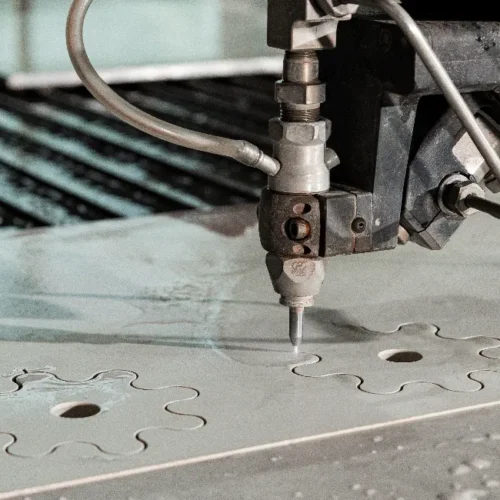
Waterjet cutting technology is a cold-cutting process that uses ultra-high-pressure water mixed with abrasive materials to cut through stone and other hard materials. The system works by pressurizing ordinary water to extremely high levels and forcing it through a tiny nozzle at tremendous speed. Abrasive particles such as garnet sand are added to the water stream, allowing the jet to erode and cut even the hardest natural and engineered stones.
In its early stages, waterjet technology was mainly used for cutting soft materials such as rubber, foam, paper, and textiles. However, with the advancement of high-pressure pump systems and CNC control technology, modern waterjet machines can now process marble, granite, quartz stone, sintered stone, porcelain slabs, ceramics, and composite materials with remarkable accuracy.
One of the most important advantages of waterjet cutting is that it is a cold process. Unlike thermal cutting methods, waterjet cutting generates almost no heat during machining. As a result, there is no heat-affected zone, no burning, and no thermal cracking. This characteristic is especially valuable when processing delicate or expensive stone materials that are vulnerable to heat stress.
Waterjet systems are particularly popular in luxury stone decoration projects because they excel at producing highly detailed and complex designs. Intricate floor medallions, artistic wall panels, decorative mosaics, curved inlays, and custom stone artwork are often created using waterjet technology. Modern CNC-controlled waterjet machines can directly import CAD drawings and execute extremely complicated cutting paths with minimal human intervention.
Another major advantage of waterjet cutting is its narrow cutting kerf. Since the cutting line is very thin, material waste is minimized. This is particularly important when processing rare or expensive natural stone slabs where maximizing material utilization significantly reduces production costs.
The Core Role of Bridge Saws in the Stone Industry
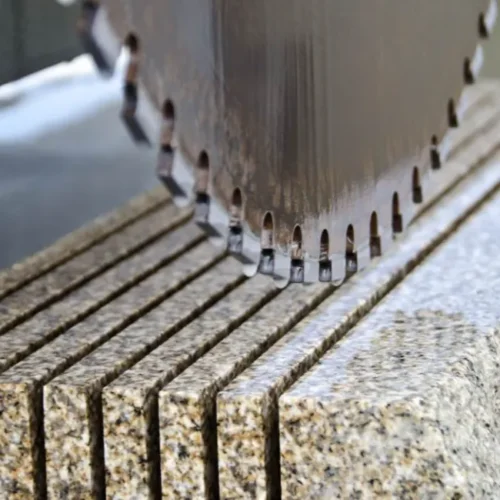
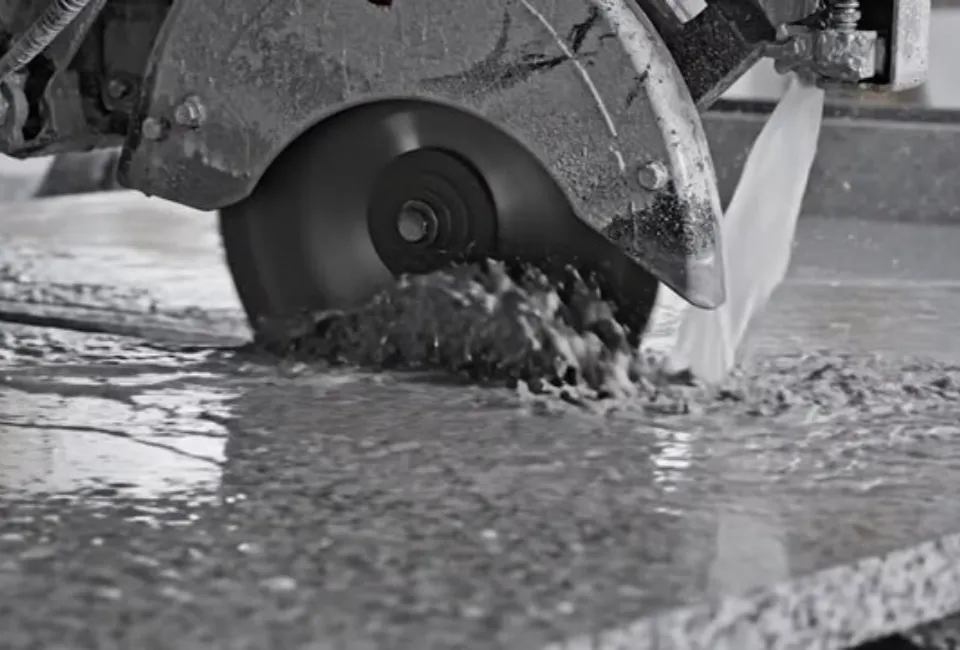
If waterjet cutting represents precision and artistic flexibility, bridge saws represent the foundation of industrial stone production. A bridge saw is a large cutting machine that uses a diamond blade mounted on a bridge-like structure spanning across the worktable. The machine is primarily used for cutting large stone slabs, straight-line cutting, edge trimming, miter cutting, grooving, and dimensional processing.
In almost every stone factory around the world, bridge saws are considered essential equipment. Whether processing granite countertops, marble flooring, wall cladding, staircases, or large engineering projects, bridge saws perform the majority of primary cutting operations.
Modern bridge saws have evolved significantly from traditional manual systems. Today’s CNC bridge saws are equipped with advanced automation features including automatic positioning, programmable cutting paths, angle cutting capabilities, and even five-axis movement. Some advanced bridge saws can perform limited shaping and contouring functions, gradually expanding their role in modern stone fabrication.
The greatest strength of bridge saws lies in their efficiency. For large-scale straight-line cutting operations, bridge saws are significantly faster than waterjet systems. They can quickly divide large slabs into standardized dimensions, making them ideal for mass production environments.
Bridge saws also offer relatively low operational costs compared to waterjet systems. Diamond blades require maintenance and replacement, but overall production costs remain highly competitive for standard cutting applications. In projects requiring large quantities of stone panels with consistent dimensions, bridge saws remain the most economical and efficient solution.
Fundamental Differences Between Waterjet Systems and Bridge Saws
Although both technologies are used for stone processing, their working principles are completely different. Waterjet cutting relies on the erosive power of high-speed abrasive water streams, while bridge saws use rotating diamond blades to mechanically cut through stone.
This difference fundamentally affects their processing characteristics. Bridge saws are contact-based cutting systems, meaning the blade physically touches and cuts the material. During processing, friction between the blade and the stone generates heat and mechanical stress. If cutting parameters are not optimized properly, issues such as edge chipping, cracking, and surface damage may occur, especially when processing brittle marble or ultra-hard porcelain slabs.
Waterjet systems, by contrast, are non-contact cutting technologies. The cutting force comes from the kinetic energy of the abrasive water stream rather than direct mechanical pressure. This greatly reduces the risk of cracking or chipping, making waterjet systems highly suitable for fragile and high-value materials.
However, bridge saws possess major advantages in straight-line cutting and high-speed production. For simple cuts and large slabs, bridge saws can complete tasks much faster than waterjet machines. Waterjet cutting tends to be slower, especially when processing thick materials or highly detailed designs.
As a result, bridge saws are generally better suited for rough cutting, slab sizing, and standardized production, while waterjet systems are more appropriate for detailed artistic work and precision customization.
Comparing Efficiency Between Waterjet Systems and Bridge Saws
Efficiency is one of the most important concerns for stone fabrication companies because production speed directly affects profitability and project timelines.
Bridge saws are widely recognized for their exceptional efficiency in mass production. For standard stone products such as floor tiles, countertops, wall panels, and stair treads, bridge saws can process large volumes quickly and consistently. A single high-performance bridge saw can complete hundreds of cuts daily with relatively simple operation procedures.
Waterjet systems, while highly precise, generally operate at slower cutting speeds. Thick stone slabs require more processing time, and highly intricate patterns may involve long cutting paths. For basic straight cuts, using a waterjet system would often increase production costs unnecessarily.
However, efficiency must be evaluated according to the specific application. In artistic stone processing, waterjet systems can actually improve efficiency significantly. Producing intricate mosaic patterns manually or using conventional saws would require extensive labor, edge grinding, and adjustment work. Waterjet systems can complete these complex patterns automatically with exceptional precision, greatly reducing labor requirements and minimizing assembly errors.
Therefore, neither technology can be universally considered more efficient than the other. Bridge saws dominate standardized production, while waterjet systems excel in custom artistic manufacturing.
Precision and Aesthetic Differences
The modern luxury construction market places increasing emphasis on visual quality, precision, and customization. In high-end hotels, villas, shopping malls, and commercial buildings, stone processing quality directly influences the final aesthetic effect.
Bridge saws can achieve high dimensional accuracy for straight cuts and angled cuts, but they are still fundamentally designed for linear processing. Complex curves, intricate patterns, and fine artistic details are difficult or impossible to produce efficiently with standard bridge saw technology.
Waterjet systems, on the other hand, possess overwhelming advantages in artistic processing. Their flexible cutting paths allow them to create circles, curves, decorative inlays, hollow patterns, and highly detailed geometric designs with extraordinary precision. Waterjet technology has become the preferred solution for luxury marble medallions, custom mosaics, and artistic stone decorations.
Another major advantage of waterjet cutting is its narrow kerf width. Smaller cutting gaps produce tighter joints and more seamless assembly results. In luxury stone mosaics, minimizing visible gaps significantly enhances visual quality and creates a more premium appearance.
Nevertheless, bridge saws maintain superior performance in large slab straightness and dimensional stability. For primary slab processing and structural cutting, bridge saws remain the ideal equipment.
The Collaborative Relationship Between Waterjet Systems and Bridge Saws
As the stone processing industry continues to evolve, modern factories increasingly focus on equipment collaboration rather than simple competition between technologies. In reality, the most effective relationship between waterjet systems and bridge saws is one of division of labor and mutual support.
In many production facilities, bridge saws perform the initial processing stages. They cut raw slabs into manageable dimensions and prepare standardized components according to project requirements. Since this stage prioritizes speed and efficiency, bridge saws are the most suitable equipment.
After rough cutting is completed, the processed slabs are transferred to waterjet systems for detailed shaping, artistic cutting, and precision customization. This workflow allows manufacturers to fully utilize the strengths of both technologies while minimizing their weaknesses.
For example, in luxury hotel lobby projects featuring elaborate marble medallions, bridge saws are first used to cut large slabs into workable sections. Waterjet systems then create the intricate decorative patterns and detailed inlays. Finally, craftsmen assemble the finished pieces into complete artistic compositions. In this process, both technologies work together seamlessly.
This collaborative model is especially important in the processing of sintered stone and porcelain slabs. Bridge saws handle the initial slab sizing, while waterjet systems are responsible for sink cutouts, stove openings, curved edges, and custom detailing. Since porcelain slabs are extremely hard and susceptible to edge chipping, waterjet systems provide major advantages during fine processing stages.
Intelligent Manufacturing and Future Integration Trends
The rise of intelligent manufacturing and Industry 4.0 is transforming both waterjet systems and bridge saws. Modern stone factories increasingly rely on automation, digital production management systems, robotic loading systems, and intelligent nesting software to improve productivity and reduce human error.
In the future, the distinction between bridge saws and waterjet systems may become less rigid. Some advanced bridge saws are beginning to integrate waterjet-assisted processing capabilities, while modern waterjet systems are improving cutting speed and automation levels.
Digital modeling and artificial intelligence are also reshaping stone processing workflows. Designers can now create digital models that are directly transmitted to CNC bridge saws and waterjet systems for fully automated production. This digital integration dramatically improves consistency while reducing manual programming time.
Environmental sustainability is another major trend influencing both technologies. Waterjet systems consume significant amounts of water, but many modern machines incorporate recycling systems that reduce waste and improve environmental performance. Bridge saw manufacturers are also developing energy-efficient motors, improved dust collection systems, and sustainable cooling technologies.
As smart manufacturing technologies continue to advance, the cooperation between waterjet systems and bridge saws will become even more sophisticated. Future factories are likely to feature highly integrated production lines where multiple machines communicate automatically and optimize production workflows in real time.
The Future Value of Waterjet Systems and Bridge Saws
Overall, waterjet systems and bridge saws should not be viewed as competing technologies where one will eventually replace the other. Instead, they represent two essential pillars of modern stone manufacturing.
Bridge saws symbolize efficiency, productivity, and large-scale industrial processing. They remain the backbone of standard stone fabrication and mass production operations. Waterjet systems represent precision, creativity, and high-end customization. They enable manufacturers to produce artistic and highly differentiated products with greater added value.
As market demand for personalized and luxury stone products continues to grow, relying solely on bridge saws is no longer sufficient for many manufacturers. At the same time, depending entirely on waterjet systems would make large-scale production inefficient and economically impractical. Therefore, combining both technologies has become the inevitable direction of industry development.
The future of advanced stone factories will likely focus less on choosing between waterjet systems and bridge saws, and more on optimizing their cooperation. Bridge saws will continue to handle high-efficiency structural processing, while waterjet systems will perform artistic detailing and precision customization. Together, they will create integrated, intelligent, and highly flexible manufacturing systems.
In the broader context of industrial modernization, the collaboration between waterjet technology and bridge saw technology not only improves production efficiency but also drives the entire stone industry toward higher quality, greater creativity, and more intelligent manufacturing. Their relationship is no longer defined by simple competition, but by cooperation, specialization, and mutual advancement. This collaborative model will remain one of the most important trends shaping the future of global stone processing.