The rapid evolution of modern manufacturing technology has continuously pushed industrial production toward higher precision, greater efficiency, and more intelligent automation. In industries such as aerospace, automotive engineering, precision instrumentation, metal fabrication, stone processing, and heavy machinery manufacturing, the selection of processing equipment directly influences product quality, production speed, manufacturing flexibility, and overall competitiveness.
Among the many advanced manufacturing technologies available today, waterjet cutting systems and CNC machining centers are two of the most widely used and influential processing solutions. Although both belong to the broader category of computer-controlled manufacturing equipment, they differ significantly in terms of processing principles, material adaptability, production efficiency, cost structure, machining accuracy, and industrial applications.
The comparison between waterjet cutting technology and CNC machining centers is not merely a technical discussion about two different types of machines. It also reflects the transformation of modern manufacturing from traditional mechanical processing toward diversified, integrated, and intelligent production systems.
Understanding the strengths and limitations of these two technologies allows enterprises to make more strategic decisions regarding equipment investment, production planning, and manufacturing optimization. Furthermore, the coexistence of waterjet systems and CNC machining centers demonstrates how different processing methods can complement rather than replace each other in industrial production.
The Development and Working Principle of Waterjet Cutting Technology
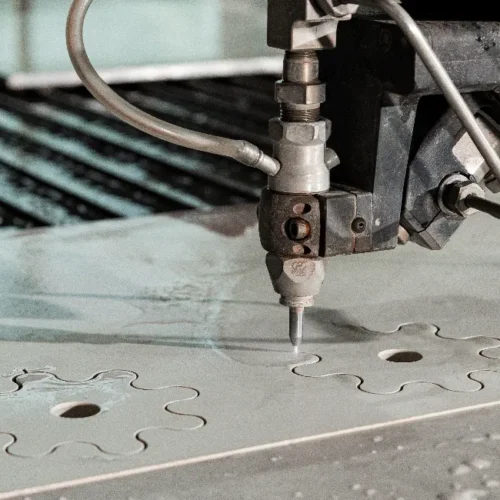
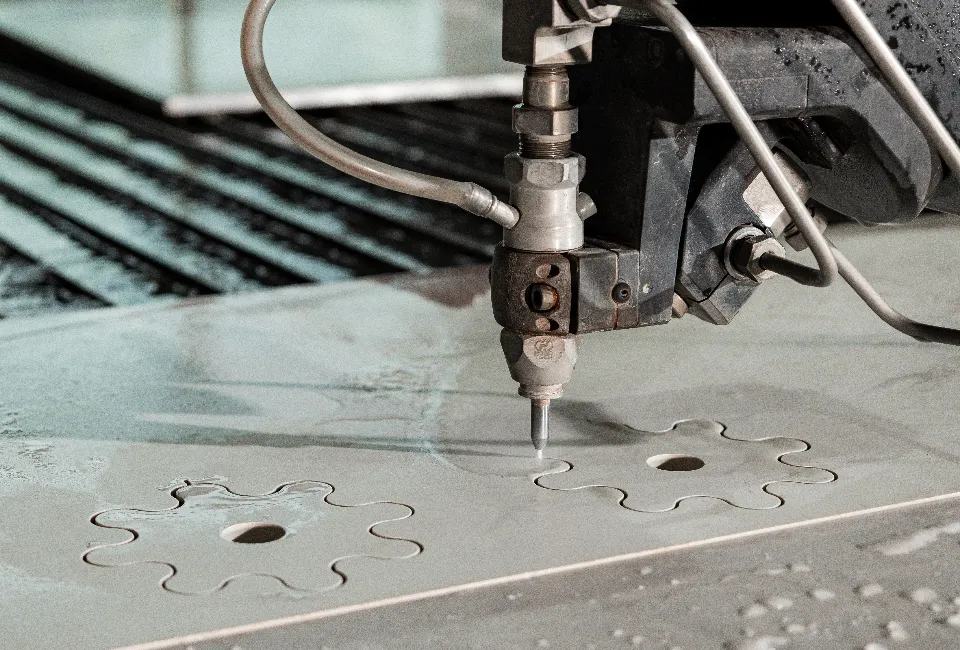
Waterjet cutting technology, also known as high-pressure waterjet machining, is a cold-cutting process that uses extremely high-pressure water streams to cut materials. The core principle involves pressurizing ordinary water to thousands of bars through a high-pressure pump and forcing it through a tiny nozzle to create an ultra-high-speed jet stream.
When cutting harder materials such as steel, titanium, ceramics, or stone, abrasive particles such as garnet sand are added to the water stream to increase cutting capability.
Initially, waterjet technology was mainly used for soft materials including paper, textiles, rubber, foam, and leather. However, with the development of ultra-high-pressure systems and advanced numerical control technology, modern waterjet equipment can now cut almost any material.
- Stainless steel
- Aluminum alloys
- Carbon fiber composites
- Ceramics
- Glass
- Marble and granite
- Bulletproof materials
One of the most important characteristics of waterjet cutting is that it is a cold process, meaning that almost no heat is generated during machining. As a result, there is no heat-affected zone, no material burning, no thermal distortion, and no metallurgical transformation.
This cold-cutting characteristic makes waterjet technology especially valuable in industries where material integrity is critical. In aerospace manufacturing, for example, titanium alloys and composite materials are highly sensitive to heat.
Traditional thermal cutting methods may alter the microstructure of these materials, reducing their strength or fatigue resistance. Waterjet cutting avoids these issues entirely and therefore has become an essential processing method in many high-end manufacturing sectors.
Modern waterjet systems are also equipped with sophisticated CNC control systems. Operators can import CAD drawings directly into the machine software, allowing the equipment to automatically follow complex cutting paths with high accuracy.
This digital integration significantly reduces human error while improving consistency and productivity. In addition, multi-axis waterjet systems now allow bevel cutting, angled cutting, and limited three-dimensional processing, further expanding the technology’s industrial applications.
The Principle and Characteristics of CNC Machining Centers
CNC machining centers are among the most important and widely used manufacturing systems in modern industrial production. CNC stands for “Computer Numerical Control,” which refers to the use of computerized programming to control machine tool movement and machining operations.
A CNC machining center can perform multiple operations including milling, drilling, tapping, boring, reaming, and contour machining within a single setup.
The basic principle of a CNC machining center involves rotating cutting tools that remove material from a workpiece through mechanical contact. The machine follows programmed tool paths generated from CAD/CAM software, ensuring highly precise movement in multiple axes.
- Three-axis machining
- Four-axis machining
- Five-axis simultaneous machining
- Complex contour machining
- Precision hole processing
Modern machining centers are capable of producing highly complex geometries that would be impossible or extremely difficult with conventional machine tools.
One of the defining advantages of CNC machining centers is automation. Most modern systems include automatic tool changers, high-speed spindles, intelligent probing systems, and advanced control software.
This enables the machine to complete multiple operations without manual intervention, dramatically improving production efficiency and repeatability. In high-volume manufacturing environments, CNC machining centers can operate continuously with minimal supervision.
Fundamental Differences Between Waterjet Cutting and CNC Machining Centers
Although both waterjet systems and CNC machining centers rely on computer numerical control technology, their machining mechanisms are fundamentally different.
- Waterjet cutting is a non-contact process
- CNC machining is a contact-based subtractive process
- Waterjet cutting uses kinetic energy
- CNC machining relies on rotating cutting tools
- Waterjet cutting produces no thermal distortion
- CNC machining provides superior 3D machining capability
In waterjet cutting, the cutting force is generated by the kinetic energy of the high-speed water stream rather than physical contact between a tool and the workpiece.
Because there is no direct mechanical pressure from a cutting tool, fragile materials such as glass, ceramics, and composite laminates are less likely to crack or deform during processing.
By contrast, CNC machining centers rely on rotating cutting tools that physically remove material from the workpiece. During machining, the workpiece experiences cutting forces, vibration, and thermal effects caused by friction.
While advanced machining techniques can minimize these effects, deformation may still occur in thin-wall structures or delicate components.
Material Adaptability Comparison
Material adaptability is another important difference between the two technologies.
Waterjet cutting can process almost any material regardless of hardness because abrasive particles perform the cutting action. Extremely hard materials that would quickly wear down traditional cutting tools can still be processed efficiently with waterjet systems.
CNC machining, however, depends heavily on tool material and cutting conditions. Machining hardened steel or advanced ceramics may require expensive cutting tools and specialized machining strategies.
| Technology | Material Compatibility | Heat Sensitivity | Suitable for Brittle Materials |
|---|---|---|---|
| Waterjet Cutting | Almost all materials | Excellent | Excellent |
| CNC Machining | Mainly metals and plastics | Moderate | Limited |
Precision and Surface Quality Comparison
Machining precision is one of the most important factors in manufacturing technology evaluation.
Modern high-end waterjet systems can typically achieve tolerances around ±0.1 millimeters, which is sufficient for many industrial applications such as sheet metal fabrication, stone processing, and composite cutting.
However, high-precision CNC machining centers can achieve tolerances measured in microns, making them essential for ultra-precision manufacturing.
Surface quality also differs significantly between the two technologies.
- CNC machining can achieve mirror-like surface finishes
- Waterjet cutting surfaces may show striation patterns
- CNC machining is better for ultra-smooth surfaces
- Waterjet cutting preserves material integrity
Although modern waterjet systems can optimize cutting parameters to reduce surface roughness, the finish quality generally cannot match that of precision CNC machining.
Despite this limitation, waterjet cutting offers an important advantage by eliminating thermal distortion and preserving the original mechanical characteristics of the material.
Efficiency and Cost Considerations
Production efficiency is a key concern for manufacturing enterprises. The efficiency of waterjet cutting and CNC machining depends heavily on the application, material type, and production requirements.
For thin sheet materials, laser cutting is often faster than waterjet cutting, while CNC machining may require longer processing times due to material removal rates.
However, when processing very thick materials, waterjet cutting demonstrates significant advantages.
- Excellent thick material cutting capability
- High edge quality on thick plates
- No thermal distortion
- Reduced secondary finishing
CNC machining efficiency is influenced by spindle speed, feed rate, cutting strategy, tool quality, and machine rigidity.
In complex part production, CNC machining centers can integrate multiple processes into a single setup, greatly reducing handling time and improving productivity.
From a cost perspective, waterjet systems often require lower initial investment compared to high-end five-axis machining centers.
However, operating costs for waterjet systems can be substantial due to continuous consumption of abrasives, water, electricity, and high-pressure component maintenance.
Industrial Applications of Waterjet and CNC Machining Technologies
The industrial applications of waterjet systems and CNC machining centers reflect their distinct technical capabilities.
- Aerospace composite cutting
- Automotive component manufacturing
- Stone processing and decoration
- Mold and die manufacturing
- Medical device production
- Energy equipment manufacturing
In the aerospace industry, waterjet cutting is frequently used for composite material trimming and titanium sheet cutting because it avoids thermal damage.
CNC machining centers are then used to produce high-precision structural components, turbine parts, and engine housings requiring micron-level tolerances.
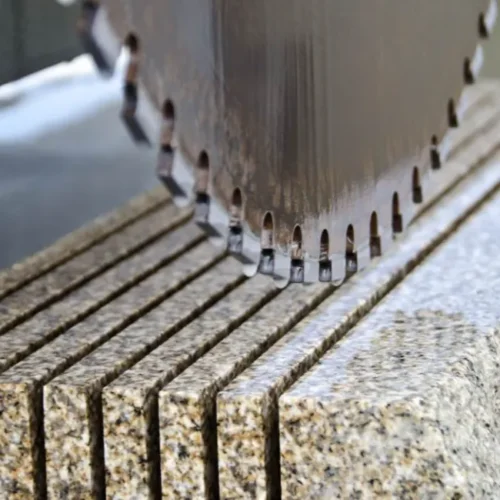
In the stone industry, waterjet systems have revolutionized decorative stone processing. Complex marble and granite patterns that were previously impossible to produce manually can now be created with exceptional precision.
CNC machining centers, on the other hand, are widely used for stone engraving and three-dimensional sculptural work.
Intelligent Manufacturing and Future Development Trends
As Industry 4.0 and intelligent manufacturing continue to evolve, both waterjet systems and CNC machining centers are becoming increasingly automated, connected, and intelligent.
- Robotic automation integration
- Digital monitoring systems
- Artificial intelligence optimization
- Automatic loading systems
- Predictive maintenance technology
Waterjet technology is advancing toward higher pressure systems, improved nozzle designs, and smarter cutting algorithms.
Ultra-high-pressure systems can now achieve finer cutting widths and faster processing speeds while improving material utilization efficiency.
CNC machining centers are evolving toward greater automation, higher spindle speeds, and enhanced multi-axis capabilities.
Artificial intelligence is increasingly being used to optimize cutting conditions, predict tool wear, and improve machining efficiency.
Future manufacturing environments are unlikely to choose exclusively between waterjet cutting and CNC machining. Instead, integrated production systems combining both technologies will become more common.
Comprehensive Evaluation of Waterjet and CNC Machining Centers
Overall, waterjet cutting systems and CNC machining centers each possess unique strengths that make them indispensable in modern manufacturing.
Waterjet technology excels in cold cutting, material versatility, and thick material processing. It is especially valuable for heat-sensitive materials, composite structures, and complex profile cutting applications.
CNC machining centers, by contrast, dominate precision manufacturing due to their exceptional dimensional accuracy, multi-process integration, and advanced three-dimensional machining capabilities.
For manufacturing enterprises, the choice between waterjet cutting and CNC machining centers should not be based on a simple comparison of superiority.
- Production requirements
- Material characteristics
- Dimensional accuracy needs
- Production volume
- Investment budget
- Long-term manufacturing strategy
In many cases, the most effective solution is not choosing one technology over the other, but integrating both into a coordinated manufacturing strategy.
As manufacturing industries continue to pursue higher efficiency, greater flexibility, and more sustainable production methods, both waterjet cutting and CNC machining technologies will continue to evolve.
Advances in automation, digital control, intelligent software, and material science will further expand their capabilities and applications. Rather than competing directly, these technologies will increasingly complement each other, contributing together to the future of advanced manufacturing and industrial innovation.